



Syngenta Plant Digital Twin
NSF FUEL Use-Inspired Research and Development Award, 2025–26
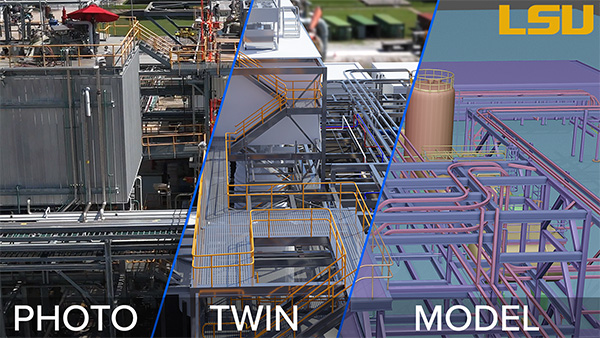
Syngenta operates a major agricultural chemical production site in St. Gabriel, Louisiana, within one of the most concentrated industrial corridors in the United States. Through the NSF-funded Future Use of Energy in Louisiana (FUEL) program, our LSU team is developing a new model for creating and deploying digital twins in chemical processing environments.
Syngenta established a clear technical vision for the project: an open-source, lightweight digital twin built from consumer-derived hardware and software. This approach keeps the facility in control of its own information, reduces dependence on proprietary platform providers, and allows data, interfaces, and capabilities to remain accessible without being locked behind a third party's subscription model. The objective is to create durable institutional infrastructure rather than another externally controlled service.
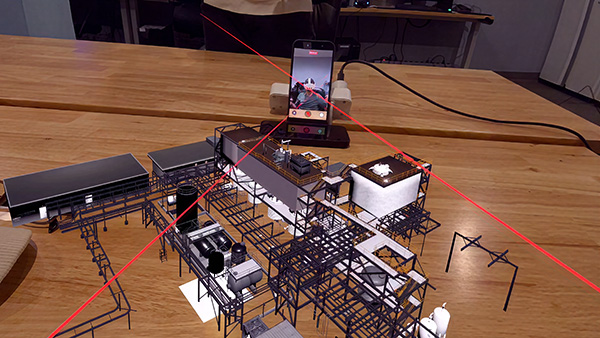
The resulting twin is built in Godot and supported by a custom software stack designed for deployment on Meta Quest 3 and related consumer platforms. Spatial models can carry informational overlays tied to equipment, processes, and locations throughout the facility. These overlays are designed to communicate operating conditions, document changes, surface relevant records, and provide users with immediate access to contextual information inside the three-dimensional environment.
The project also demonstrates how entertainment technologies can serve as industrial research infrastructure. Real-time engines, immersive interfaces, digital asset pipelines, and interaction design methods developed for games and virtual production provide a faster and more flexible foundation for representing complex facilities. By adapting these methods to chemical processing, we are creating a pathway from highly specialized digital-twin projects toward systems that can be produced, updated, and deployed at a much broader scale.
The central innovation is accessibility. A lower-cost and more repeatable workflow allows facilities to begin with a focused operational use case, establish value quickly, and expand the twin as new needs emerge. This makes digital-twin adoption possible across a wider range of plants, processes, and organizations, including sites that have historically lacked the capital, staffing, or technical infrastructure required for large enterprise platforms.
Louisiana’s chemical corridor provides an ideal proving ground for this work. The region combines dense industrial infrastructure, a highly skilled workforce, major energy and chemical producers, and an urgent need for tools that support modernization, resilience, safety, and knowledge transfer. A successful model at St. Gabriel can inform a scalable digital-twin framework for facilities throughout Louisiana and across the broader industrial sector.
The Syngenta project extends LSU’s leadership in digital twins, simulation, immersive computing, and advanced visualization into a new industrial domain. It demonstrates how design-led research can reduce technical barriers, translate complex information into usable systems, and create practical infrastructure for the next generation of intelligent manufacturing and chemical processing.